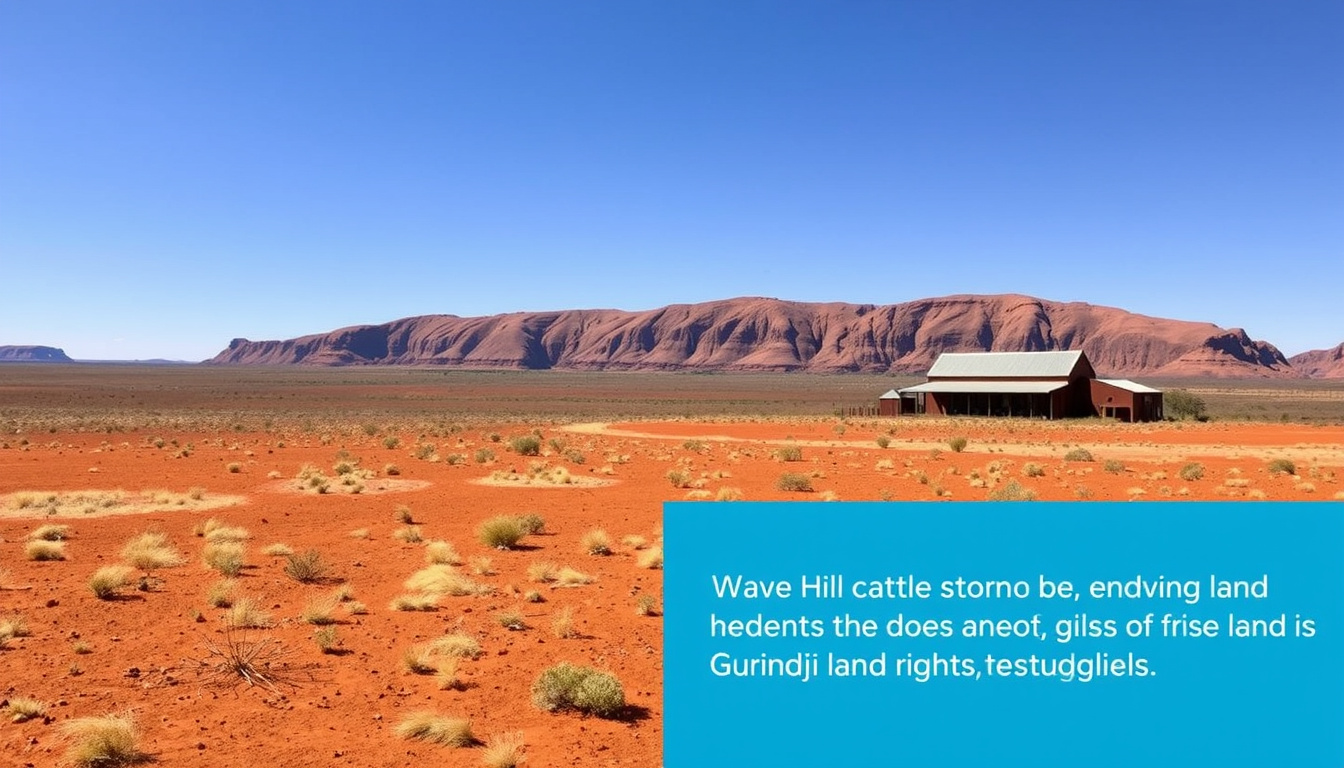
When Vincent Lingiari led 200 Gurindji workers and their families off Wave Hill cattle station on 23 August 1966, the strike was meant to last weeks. Instead, it became one of the most significant acts of Indigenous resistance in Australian history. What began as a protest over wages and conditions evolved into a nine-year campaign that would reshape the legal landscape for First Australians. The outcome eventually influenced national land rights legislation and remains a defining moment in the country’s journey toward reconciliation.
Start date: 23 August 1966 · Leader: Vincent Lingiari · Participants: 200 Gurindji stockmen and families · Duration: 9 years until 1975 land return · Location: Wave Hill Station, Northern Territory
Quick snapshot
- 200 Gurindji walked off Wave Hill on 23 August 1966 (Amnesty International Australia)
- Gough Whitlam handed land back on 16 August 1975 (National Archives of Australia)
- The precise dividing line between active strike (job action) and land rights campaign (political advocacy)
- Exact number of family members versus workers among the 200 participants
- The period from 1966–1975 spans both the industrial dispute and the political resolution phase
- Key transition point was 1968 when Lingiari petitioned PM Holt for land specifically, shifting the demand beyond wages
- Native title over Wave Hill station granted September 2020, 54 years after the walk-off (National Museum of Australia)
- Ongoing commemoration and education about the legacy continues in NT and nationally (National Museum of Australia)
| Label | Value |
|---|---|
| Event name | Wave Hill walk-off (Gurindji strike) |
| Date started | 23 August 1966 |
| Leader | Vincent Lingiari |
| Number of walkers | 200 |
| End milestone | 16 August 1975 |
What happened with the Wave Hill walk-off?
On 23 August 1966, over 200 Gurindji workers and their families left Wave Hill cattle station in the Northern Territory. The walk-off, led by Gurindji Elder and union leader Vincent Lingiari, was coordinated with Dexter Daniels, an Indigenous organiser for the North Australian Workers Union, and involved workers from Gurindji, Ngarinman, Bilinara, Warlpiri, and Mudbara groups. Vestey Brothers, a British company that had owned the station since 1914, refused demands for equal pay, and workers had been paid in kind rather than cash while living in overcrowded, substandard housing.
Vestey Brothers made significant profits from cattle operations that depended on Gurindji labour, yet the workers who sustained the enterprise were denied basic wages and the right to live on their own land.
Background at Wave Hill Station
The British company Vestey Brothers purchased Wave Hill Station in 1914, gradually taking control of Gurindji traditional lands that had covered approximately 3,250 square kilometres before European settlement. Gurindji people had lived and worked on these lands for millennia, but the station’s expansion displaced communities from their country. Workers were employed as stockmen but received payment in kind—food, tobacco, clothing—rather than wages, and faced overcrowded and poor living conditions on the station.
The walk-off on 23 August 1966
The decision to walk off the station came after Vestey Brothers refused to meet equal pay demands. With support from union organiser Dexter Daniels, the North Australian Workers Union, Waterside Workers Federation, and Australasian Meat Industry Employees Union, workers left their jobs on 23 August 1966. Writer Frank Hardy helped create a sign asserting Gurindji land rights that same year, and the “Save the Gurindji” committee launched boycotts of Vestey products beginning 28 August 1966. The strike quickly gained traction as unions backed the action, and the walk-off became more than an industrial dispute—it became a statement about Aboriginal rights to land.
Why did the walk-off happen?
The walk-off was triggered by Vestey Brothers’ refusal to grant equal pay demands, but the deeper cause was decades of dispossession and poor conditions. Workers received payment in kind instead of cash wages, meaning they could not save money or live independently. Overcrowded housing, discrimination, and the fundamental injustice of being paid to work on land their ancestors had owned for thousands of years fueled the decision to act. The event drew on a broader tradition of Aboriginal resistance, though it was not the first such strike—prior actions at places like Brunette Downs Station had sought similar outcomes. What distinguished the Wave Hill walk-off was the scale of public and union support it generated.
Work and living conditions
Gurindji stockmen at Wave Hill performed physically demanding work handling cattle across vast pastoral lands. Despite this labour, Vestey paid workers in kind rather than providing regular cash wages. Families lived in cramped quarters on the station with limited access to proper facilities. The conditions reflected a broader pattern across northern Australian pastoral stations, where Indigenous workers were systematically underpaid and marginalised. The protest challenged not only wage inequality but the entire system that treated Aboriginal labour as expendable.
Historical context of Aboriginal labor
Across northern Australia, Indigenous workers had long been exploited in the pastoral industry. Wave Hill was not an isolated case—Aboriginal workers at other stations faced similar conditions—but the 1966 walk-off became the most significant in terms of eventual legislative impact. While white union supporters focused on wages and working conditions, Gurindji leaders like Lingiari had a different priority: recovering their traditional country. This difference in emphasis would shape how the campaign evolved and ultimately what it achieved.
The gap between what union supporters wanted (higher wages) and what Gurindji wanted (land return) reveals a tension that shaped the campaign’s direction. Lingiari reportedly told Vestey: “You can keep your gold. We just want our land back.”
How did the Wave Hill walk-off end?
The walk-off itself lasted only days—workers established a camp at Wattie Creek, which they named Daguragu. What followed was not a traditional strike ending but a years-long political campaign. Gurindji families remained at Daguragu for nine years while pursuing their land claim through petitions, negotiations, and political pressure. The Australian government eventually took action: in 1973, Prime Minister Gough Whitlam authorised funds through the Aboriginal Land Fund Commission to purchase part of Wave Hill from Vestey.
Establishment of Daguragu camp
After walking off Wave Hill in August 1966, Gurindji workers and families moved to Wattie Creek, establishing the camp that became known as Daguragu. This location held deep significance as traditional Gurindji country, and the camp became both a physical community and a symbol of the demand for land return. Over the following years, Gurindji families remained at Daguragu, with some attempting to develop cattle and mining operations to demonstrate productive use of the land. The camp’s continued existence was itself a form of protest and persistence.
Land rights negotiations
In June 1966, before the walk-off, Gurindji had already petitioned Governor-General Lord Casey requesting a 1,300 square kilometre lease around Daguragu for cattle and mining purposes, declaring “We feel that morally the land is ours and should be returned to us.” That petition was refused. In 1968, Vincent Lingiari travelled to Canberra to present his case directly to Prime Minister Harold Holt. When the Whitlam Labor government came to power in 1972, with its stated interest in land rights, momentum accelerated. In 1973, Whitlam authorised government purchase of land for the Gurindji. On 16 August 1975, one year before his government was dismissed, Whitlam travelled to Daguragu for a ceremony that would become iconic in Australian history.
What happened to Vincent Lingiari?
Vincent Lingiari remained the central figure throughout the nine-year campaign. He had worked at Wave Hill Station for decades and was chosen as union delegate because of his standing as a Gurindji Elder and his ability to speak across language groups. His role went beyond industrial negotiation—he became the public face of the land rights movement and a figure recognised nationally for his leadership.
Leadership role
As union delegate and community Elder, Lingiari commanded respect across the diverse groups involved in the walk-off—Gurindji, Ngarinman, Bilinara, Warlpiri, and Mudbara workers all looked to him. His leadership was both practical (organising the walk-off, coordinating with union supporters) and symbolic (articulate in his demand for land return). The walk-off required sustained leadership over years when a simpler dispute might have been resolved in weeks. Lingiari maintained community cohesion at Daguragu through difficult periods and continued advocating for land rights even as negotiations stretched on.
Later recognition
Lingiari lived to see the land return in 1975, standing with Gough Whitlam as the Prime Minister poured red earth into his hands and declared the deeds would prove, in Australian law, that the lands belonged to the Gurindji people. Whitlam’s speech that day was direct: “Vincent Lingiari, I solemnly hand to you these deeds as proof, in Australian law, that these lands belong to the Gurindji people.” Lingiari received recognition for his role, including the Member of the Order of the British Empire (MBE) in 1977. He continued advocating for Aboriginal rights until his death, with his legacy cemented as the man who led the walk-off that sparked national change.
Was the Wave Hill Walk-off successful?
By every measure that matters, yes. The walk-off that began in August 1966 eventually became the catalyst for Aboriginal land rights legislation—the first of its kind in Australia. While the path was longer than anyone imagined, and the initial land handover was partial, the campaign achieved its central objective: recognition that First Australians had rights to their traditional lands that the law could no longer ignore.
Land rights achievements
The most concrete achievement was the Aboriginal Land Rights (Northern Territory) Act 1976, passed by the federal parliament and directly influenced by the Gurindji campaign. This was the first Australian legislation establishing a system for Indigenous people to claim land based on traditional association rather than purchase. The Act created a framework for land councils to hold and manage land on behalf of Traditional Owners, with the Gurindji as one of the first groups to benefit. Native title over Wave Hill Station was finally granted in September 2020—54 years after the walk-off—but the 1976 Act provided the legal pathway to that recognition.
Broader influence
The Wave Hill walk-off marked the first time Aboriginal land rights gained significant public support in Australia and became the most important Aboriginal strike in terms of legislative impact. Its influence extended beyond the Northern Territory: the campaign demonstrated that sustained action could force governments to recognise Indigenous rights, and the 1976 Act became a model for subsequent land rights legislation. The symbolic image of Whitlam placing earth in Lingiari’s hands entered Australian national consciousness, and the walk-off is now taught in schools as a defining moment in the nation’s history. For Indigenous communities across Australia, the outcome proved that legal recognition of land rights was achievable through political pressure and persistence.
Timeline
| Date | Event |
|---|---|
| 1914 | Vestey Brothers purchase Wave Hill Station |
| June 1966 | Gurindji petition Governor-General Lord Casey for land lease |
| 23 August 1966 | Gurindji workers walk off Wave Hill Station |
| 1966–1967 | Daguragu camp established at Wattie Creek |
| 1968 | Vincent Lingiari petitions Prime Minister Holt for land |
| 1973 | Whitlam authorises government land purchase funds |
| 16 August 1975 | Gough Whitlam returns land to Gurindji at Daguragu ceremony |
| 1976 | Aboriginal Land Rights (Northern Territory) Act passed |
| September 2020 | Native title granted over Wave Hill Station |
Clarity on key facts
Research confidence for most core claims is high, supported by tier 1 government sources. A few areas remain less certain:
Confirmed
- Walk-off date: 23 August 1966
- Participants: 200 Gurindji workers and families
- Whitlam land handover: 16 August 1975
- Strike duration: nine years until land return in 1975
- Native title: granted September 2020
Less Certain
- Precise distinction between active strike period versus land rights campaign phase
- Exact family member breakdown among the 200 participants
- Full economic impact of Vestey product boycotts
Key quotes
“You can keep your gold. We just want our land back.”
— Vincent Lingiari, Gurindji Elder and leader of the walk-off (Amnesty International Australia)
“Vincent Lingiari, I solemnly hand to you these deeds as proof, in Australian law, that these lands belong to the Gurindji people.”
— Gough Whitlam, Prime Minister of Australia, 16 August 1975 (National Museum of Australia Digital Classroom)
“We feel that morally the land is ours and should be returned to us.”
— Gurindji petition to Governor-General Lord Casey, 1966 (Wikipedia)
For Indigenous Australians, the significance of the Wave Hill walk-off extends beyond its legal outcomes. The act of walking off their own land to demand its return—that paradox of leaving to reclaim—symbolised the absurdity of colonisation’s displacement. Vincent Lingiari’s statement that the Gurindji wanted their land back, not gold, captured what the pastoral industry could not understand: that for Traditional Owners, country was not a commodity but identity, history, and belonging. The eventual return of Daguragu and the 1976 legislation showed that persistence and political pressure could overcome legal systems designed to exclude Indigenous claims.
Related reading: Wave Hill Station
Frequently asked questions
What started the Wave Hill walk off?
The walk-off began on 23 August 1966 when over 200 Gurindji workers and families left Wave Hill Station. The immediate trigger was Vestey Brothers’ refusal to meet equal pay demands, but the deeper cause was decades of low wages paid in kind, poor living conditions, and the fundamental injustice of being forced to work on land that had been taken from their ancestors.
How long did the Wave Hill walk-off last?
The physical walk-off from the station lasted only days—workers established a camp at Wattie Creek and remained there. However, the campaign for land rights continued for nine years until Prime Minister Gough Whitlam returned land to the Gurindji on 16 August 1975. Native title over Wave Hill Station was finally granted 54 years later, in September 2020.
What was happening at the time that caused the walk-off?
The walk-off occurred during a period when union movement support for Aboriginal rights was growing, and the Australian public was becoming more aware of Indigenous disadvantage. Vestey Brothers, a British company, had operated Wave Hill Station since 1914, and Gurindji workers had long been paid in kind rather than cash. The 1966 equal wages case for pastoral workers created momentum for change, and Gurindji workers decided to take direct action rather than wait for slow industrial processes.
Are there still Aboriginal people living in Australia?
Yes, Aboriginal and Torres Strait Islander peoples are the First Australians, with continuous presence on this continent for over 65,000 years. Today there are approximately 800,000 Indigenous Australians, representing around 3.3% of the national population. The Wave Hill walk-off and subsequent land rights legislation emerged from this living culture’s ongoing connection to country.
Which prime minister returned the land in 1975?
Prime Minister Gough Whitlam returned the land to the Gurindji people on 16 August 1975 during a ceremony at Daguragu (Wattie Creek). At the ceremony, Whitlam poured red earth into Vincent Lingiari’s hands and formally transferred the deeds, stating they proved in Australian law that the lands belonged to the Gurindji. Whitlam’s government had been dismissed by Governor-General John Kerr just weeks later, on 11 November 1975.
What is the Wave Hill walk-off song?
The walk-off inspired several songs over the years, most notably “From the Land” and other folk songs created during the 1960s and 1970s that became part of the broader protest music movement. Australian folk musicians including the band The Beans and various union supporters created songs documenting the struggle. These songs helped spread awareness of the campaign beyond the Northern Territory and contributed to the national conversation about Aboriginal rights.
Was the Wave Hill Walk-off successful?
Yes—the walk-off was successful beyond what its participants imagined. It directly led to the Aboriginal Land Rights (Northern Territory) Act 1976, the first legislation allowing Indigenous Australians to claim land based on traditional association. The Gurindji got their land back in 1975, and native title over Wave Hill was finally granted in September 2020. The campaign also sparked a national land rights movement and remains a touchstone for Indigenous rights in Australia.
What is Wave Hill Walk-off 2026?
2026 marks the 60th anniversary of the Wave Hill walk-off. Commemorative events and educational programs are planned across Australia to recognise this pivotal moment in Indigenous rights history. The anniversary provides an opportunity to reflect on progress made since 1966 and the work that remains in reconciliation and land rights.

Andrew Ellis leads fact-checking, source verification and corrections at Oz Insightlab.