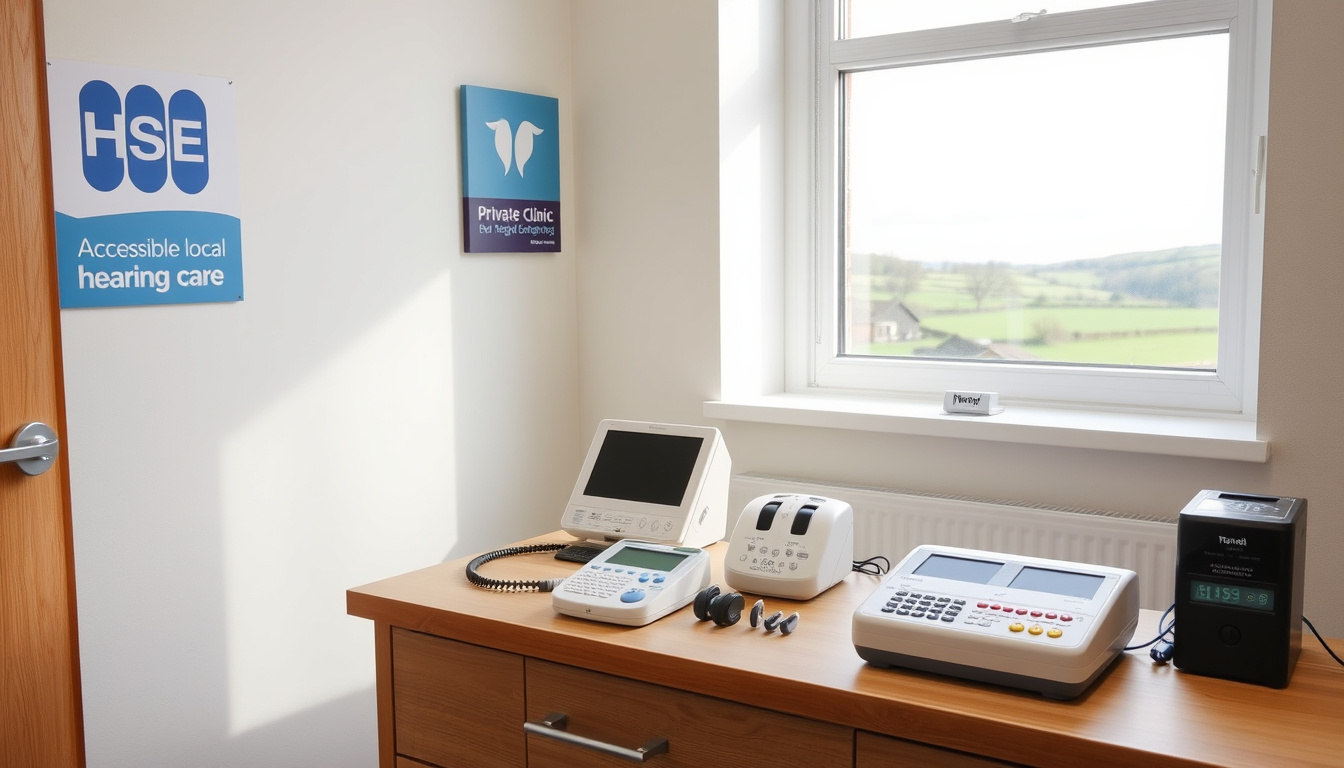
If you’ve been repeating yourself in conversations or cranking up the TV volume, finding an audiologist near you in Ireland probably feels urgent. Public and private options both exist — but the pathway you take determines how much you pay, how long you wait, and whether you need a referral at all.
HSE audiology centres: 24 counties across Ireland ·
Hidden Hearing clinics: over 80 in Ireland and Northern Ireland ·
PRSI grant: up to €500 per hearing aid, claimable every 4 years ·
Private test from: €65
Quick snapshot
- HSE requires GP referral to access audiology centres (HSE.ie)
- Medical card holders and children under 18 get free hearing aids (HSE.ie)
- PRSI grant pays up to €500 per aid every 4 years (Blackberry Hearing)
- Exact current waiting times for HSE assessments and fitting — vary by region and demand
- Minimum PRSI contribution thresholds to qualify for the Treatment Benefit Scheme grant
- Whether any private providers accept partial HSE subsidies beyond the PRSI scheme
- HSE audiology centres operate across 24 counties with ongoing referral-based access
- PRSI grant claimable once every 4 years per hearing aid
- Hidden Hearing has expanded its private network to over 80 Irish clinics
- Adults without medical cards weighing private costs may first check PRSI eligibility
- HSE waiting lists mean some patients seek private audiologists for faster appointments
- Cochlear implant cases continue to be referred to Beaumont Hospital, Dublin
Key facts about accessing audiology services in Ireland are summarized below.
| Label | Value |
|---|---|
| Primary service | Hearing tests and hearing aids |
| HSE access | Referral-based through GP or ENT |
| Private clinics | Over 80 locations across Ireland |
| Self-referral | Available through private providers; not standard HSE route |
| HSE free eligibility | Medical card holders and children under 18 |
| PRSI grant amount | Up to €500 per hearing aid |
| Free repairs | Covered by HSE for issued aids; half cost via Treatment Benefit |
| Cochlear implants | Specialist unit at Beaumont Hospital, Dublin |
How is an audiologist different from an ENT?
Audiologists and ENT (ear, nose, and throat) specialists both work with hearing problems, but they serve distinct roles in the healthcare system.
Role of audiologist
- Conducts hearing tests, typically in a soundproof booth
- Fits and dispenses hearing aids and assistive devices
- Manages hearing rehabilitation and auditory training
- Can refer patients to ENT if medical issues are detected
Role of ENT
- Holds a medical degree (MRCPI or equivalent) with surgical training
- Diagnoses and treats infections, perforations, tumors, and structural issues
- Can refer patients to audiology for hearing aid assessment
- Handles cochlear implant referrals and surgery
When to see each
- Start with a GP for general hearing concerns — they can refer to either specialist
- See an ENT if you have ear pain, drainage, sudden hearing loss, or suspected infection
- See an audiologist for hearing tests, aid fitting, or balance assessment
Does it cost to see an audiologist?
Costs in Ireland depend heavily on your eligibility status — whether you hold a medical card and how old you are.
HSE costs
- Hearing tests through HSE are free if you have a medical card or are under 18
- Medical card holders receive hearing aids at no charge (HSE.ie)
- Free repairs are available at local HSE services or the National Hearing Aid Repair Centre
Private costs
- Private hearing tests start from €65 in Ireland (WhatClinic)
- Hearing aids themselves range from budget models under €500 to premium devices above €3,000
- Private audiologists like Hidden Hearing and Hearing Solutions offer walk-in or booked appointments
Over 60s exemptions
- Adults over 60 without medical cards can access the Treatment Benefit Scheme PRSI grant
- The grant covers up to €500 per hearing aid, claimable once every 4 years (Blackberry Hearing)
- Some private clinics offer aids effectively free once the PRSI grant is applied
- The Treatment Benefit Scheme also covers half the cost of hearing aid repairs
Can I self refer to an audiologist?
The referral pathway depends on whether you’re using public HSE services or going private.
Self-referral process
- HSE audiology services officially require a referral from your GP or ENT specialist
- You cannot self-refer directly to a HSE audiology centre
- Private audiologists accept patients without referral — some recommend one anyway
HSE vs private
- HSE route: GP referral → waiting list → assessment → aid fitting (free if eligible)
- Private route: direct booking → immediate assessment → pay out-of-pocket or claim PRSI
- Some private providers like UPMC Aut Even Hospital do not strictly require referral but recommend it (UPMC Ireland)
Choosing your path
- If you have a medical card and can wait, HSE is free
- If you want faster access or don’t qualify for HSE, private is the direct route
- Walker Hearing Clinics recommends GP or ENT referral for non-HSE patients to ensure proper diagnosis (Walker Hearing)
How do I get a hearing test with the HSE?
The HSE audiology pathway runs through your GP first, then directs you to the nearest centre.
Referral steps
- Step 1: Visit your GP and explain your hearing concerns
- Step 2: GP sends a referral to the HSE audiology service
- Step 3: You are added to a waiting list for assessment at your nearest HSE centre
- Step 4: Attend the appointment — hearing test conducted in a sound booth
- Step 5: If aids are recommended, you are fitted and provided with the device
Audiology centres
HSE audiology centres operate in every Irish county. The national network covers 24 counties including Dublin, Cork, and Galway, with some smaller counties sharing a single service location.
Regional examples
- Dublin: Grangegorman (01 867 6263) and Tallaght (01 795 7616) — separate lines for adults and children
- Cork: St. Finbarr’s Hospital, Douglas Road — call 021 492 7240
- Galway: 10 Ely Place — call 091 582 111
- Sligo/Leitrim: Shared service at Old Nazareth House, Sligo
What are three warning signs of hearing loss?
Recognizing hearing loss early improves outcomes — and some signs are easier to dismiss than they should be.
Red flags for audiology
- Struggling to follow conversations, especially in groups or noisy environments
- Frequently asking others to repeat themselves or speak louder
- Turning the TV or radio up to a volume others find uncomfortable
- Ringing or buzzing in the ears (tinnitus)
- Feeling that people are mumbling rather than speaking clearly
The 60-60 rule
- Audiologists sometimes use the 60-60 rule as a screening guideline: if you need 60 decibels of amplification to hear at 60 feet, further testing is warranted
- This is not a formal diagnosis but a useful self-check signal to see your GP
When to act
- Sudden hearing loss in one or both ears — see your GP or ENT immediately
- Gradual decline over months or years — book a hearing test
- Children showing signs of delayed speech or inattention — audiology assessment is especially important
Many adults delay getting assessed because they assume hearing loss is a normal part of ageing they just have to accept. But the longer you wait, the harder hearing rehabilitation becomes — and the longer the HSE waiting list, the more incentive to go private at your own cost.
Two pathways shape how you access audiology in Ireland — and they come with different trade-offs.
The comparison below outlines how the public HSE system and private audiologists differ across key factors.
| Factor | HSE Public Audiology | Private Audiologists |
|---|---|---|
| Referral required | Yes — GP or ENT | No — direct booking |
| Cost | Free (medical card/under 18); otherwise ineligible | €65+ for test; aids from €500 to €3,000+ |
| Waiting time | Yes — varies by region and demand | Minimal — often same-week booking |
| Eligibility | Medical card holders and under-18s priority | Anyone can book |
| Grant support | None directly — scheme runs through DEASP | PRSI Treatment Benefit up to €500 per aid |
| Coverage | 24 counties with shared services in some regions | Over 80 Hidden Hearing locations; multiple private networks |
Upsides
- Free hearing tests and aids for medical card holders and children under 18
- PRSI Treatment Benefit Scheme grants up to €500 per hearing aid every 4 years
- HSE centres exist in every Irish county — national coverage
- Free hearing aid repairs through the National Hearing Aid Repair Centre
- Private options offer same-week access without waiting lists
Downsides
- HSE route requires GP referral — no self-referral allowed
- HSE waiting lists mean weeks or months of delay after referral
- Non-medical card adults pay privately or rely on the PRSI grant alone
- Private hearing tests start from €65 with no guarantee of grant approval
- Some smaller counties share HSE services, reducing local access
HSE audiology serves those who qualify quickly in theory but not in practice due to waiting lists. Private audiologists fill that gap — but only for those who can afford to pay or who successfully claim the PRSI grant. The two systems run in parallel rather than as true alternatives.
Steps to get a hearing test in Ireland
Whether you go public or private, the practical steps follow a broadly similar path.
- Book a GP appointment — explain your hearing concerns and request a referral or recommendation
- Ask about eligibility — check whether you hold a medical card or qualify for the Treatment Benefit Scheme
- For HSE: get referred — your GP sends a referral to the nearest HSE audiology centre
- For HSE: join the waiting list — expect a delay before your assessment appointment arrives
- For private: book directly — providers like Hidden Hearing (over 80 locations), Hearing Solutions, and Audiology Medical Services accept direct bookings
- Attend the hearing test — conducted in a sound booth; tests your threshold across frequencies
- Discuss results and options — audiologist explains amplification needs and recommends aid types
- Get fitted — aids are programmed to your audiogram; adjustments made for comfort
- Arrange aftercare and repairs — HSE users return to local services; private users contact their provider
“The HSE audiology service gives free hearing aids to anyone under the age of 18. Adults with a medical card can also get free hearing aids.”
— Irish Health Service Executive (HSE.ie)
“The grant can cover up to €500 per hearing aid. The grant can be claimed once every four years.”
The practical choice for most adults without a medical card is straightforward: check whether you have sufficient PRSI contributions to claim the Treatment Benefit Scheme, then decide whether to wait for HSE or pay privately for faster access. Hidden Hearing’s network of over 80 Irish clinics means most patients live within a reasonable distance of a private provider, which removes one traditional barrier to going private.
Related reading: Servo Near Me · Turnip Cake Near Me
www2.hse.ie, hearingaidknow.com, hearingsolutions.ie, www2.hse.ie
Frequently asked questions
What is the 60-60 rule in audiology?
The 60-60 rule is an informal screening guideline: if you need 60 decibels of amplification to hear clearly at a 60-foot distance, it suggests hearing loss worth investigating. It is not a clinical diagnosis but a useful prompt to book a GP appointment.
Do over 60s pay for hearing aids?
Adults over 60 without a medical card pay privately or through the PRSI Treatment Benefit Scheme. The scheme provides up to €500 per hearing aid, claimable every 4 years, which can significantly reduce out-of-pocket costs. Medical card holders of any age receive aids free of charge.
What are the disadvantages of an audiologist?
The main drawbacks are cost if you are not eligible for HSE services, potential waiting times through the public system, and the fact that audiologists cannot prescribe medication or perform surgery — those require an ENT specialist.
What are the red flags for audiology referrals?
Warning signs include struggling to follow conversations, turning up the TV volume uncomfortably high, frequently asking for repetition, tinnitus (ringing in the ears), and a feeling that others are mumbling. Sudden hearing loss in one or both ears is a medical urgency — see your GP immediately.
Can I self refer for a hearing test?
You cannot self-refer to a HSE audiology centre — a GP or ENT referral is required. However, private audiologists accept direct bookings. Some private providers recommend a GP visit first for a full medical assessment, but it is not mandatory.
What are three warning signs of hearing loss?
Difficulty following conversations in noisy environments, consistently needing to raise the volume on devices to levels others find uncomfortable, and frequently asking others to repeat themselves are three common early signs. Tinnitus and the perception that people are mumbling are also worth taking seriously.
What costs apply for hearing aid repairs?
HSE-issued hearing aids receive free repairs at local HSE services or the National Hearing Aid Repair Centre. For privately purchased aids, the Treatment Benefit Scheme covers half the cost of repairs. Out-of-warranty repairs through private providers vary by device type and provider.

Liam O'Brien covers Australian politics and public affairs for Oz Insightlab.