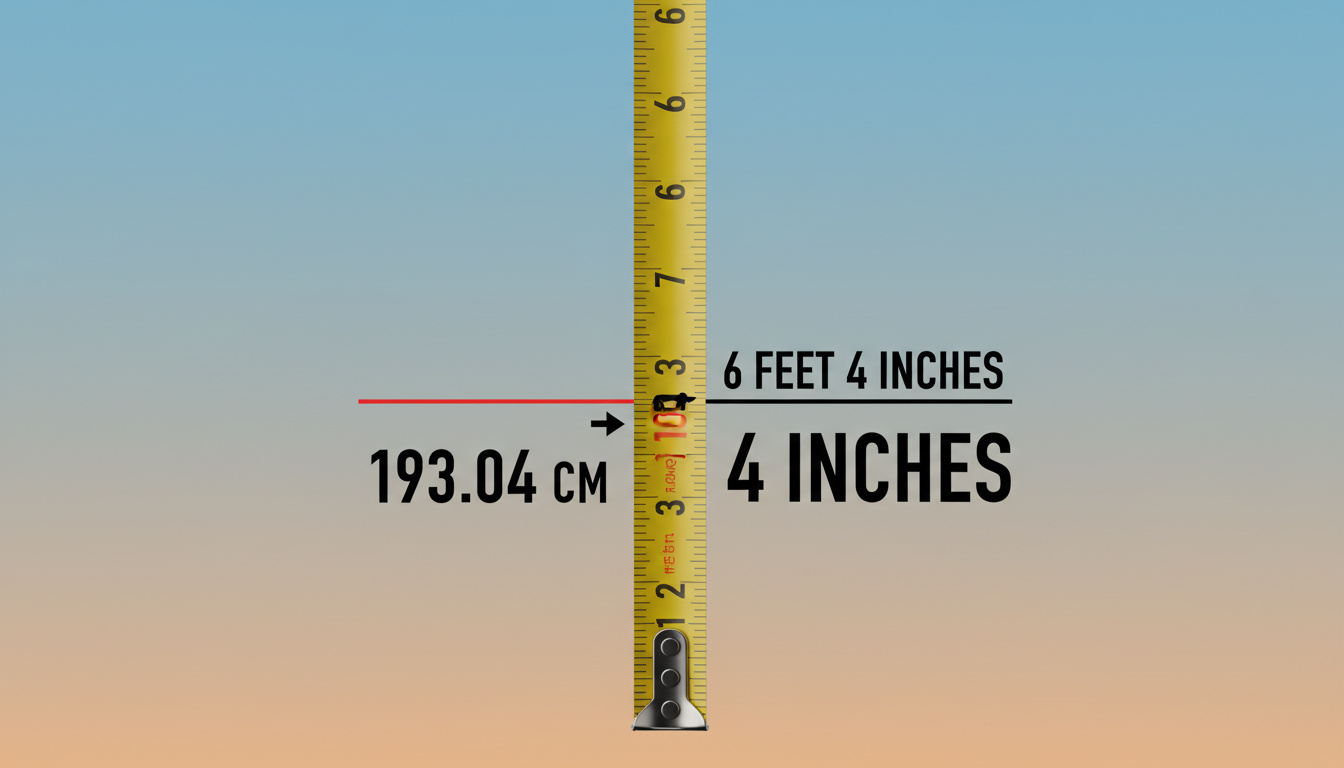
Six feet four inches converts to exactly 193.04 centimeters, a measurement established by international metrology standards since 1959.
This specific height represents a significant statistical outlier globally, exceeding the stature of approximately 99 percent of adult men and nearly 100 percent of women worldwide. The conversion relies on precise mathematical constants defined by the International Organization for Standardization and the National Institute of Standards and Technology.
Understanding this measurement requires examining both the exact conversion formula and its practical implications across medical, athletic, and everyday contexts where metric and imperial systems intersect.
What Is 6’4 in Centimeters?
| Imperial | Centimeters | Meters | Statistical Category |
|---|---|---|---|
| 6’0″ | 182.88 cm | 1.83 m | Above Average |
| 6’2″ | 187.96 cm | 1.88 m | 90th Percentile US |
| 6’4″ | 193.04 cm | 1.93 m | Elite Height |
| 6’6″ | 198.12 cm | 1.98 m | Pro Basketball |
- Exact conversion: 193.04 cm with zero variance under current ISO standards
- Metric equivalent: 1.9304 meters
- Inch total: 76 inches exactly
- US male percentile: 95th to 97th according to CDC anthropometric data
- Global standing: Exceeds 99.9% of adult men worldwide
- Standard basis: ISO 80000-2:2019 and NIST Handbook 44 definitions
| Feet/Inches | Centimeters | Meters | Reference Context |
|---|---|---|---|
| 5’10” | 177.80 cm | 1.78 m | US Male Average |
| 6’0″ | 182.88 cm | 1.83 m | Tall threshold |
| 6’2″ | 187.96 cm | 1.88 m | 90th percentile US |
| 6’4″ | 193.04 cm | 1.93 m | Elite height |
| 6’5″ | 195.58 cm | 1.96 m | NFL Quarterback range |
| 6’6″ | 198.12 cm | 1.98 m | NBA average |
How Do You Convert Feet and Inches to CM?
Step-by-Step Formula
The conversion follows a two-part calculation based on exact international constants. One foot equals exactly 30.48 centimeters, while one inch equals exactly 2.54 centimeters.
First, multiply six feet by 30.48 to obtain 182.88 centimeters. Then multiply four inches by 2.54 to obtain 10.16 centimeters. Adding these values yields 193.04 centimeters as confirmed by precision calculation tools.
Alternatively, convert total inches first: six feet equals 72 inches, plus four inches equals 76 inches. Multiplying 76 by 2.54 produces the identical result verified by conversion specialists. The inches-to-centimeter factor derives from the exact definition of 25.4 millimeters per inch as established in mathematical standards.
cm = (feet × 30.48) + (inches × 2.54). This formula produces exact results with no rounding necessary for standard measurements, as both conversion factors are defined exactly by international treaty.
Is 6’4 Height Considered Tall?
Male vs Female Averages
Among adult men in the United States, the average stature stands at 175.3 centimeters (5 feet 9 inches) according to CDC anthropometric reference data collected between 2015 and 2018. For women, the average measures 161.5 centimeters (5 feet 3.5 inches). Both figures place 193.04 centimeters significantly above the mean according to global anthropometric compilations.
Global Percentiles
Globally, adult men average approximately 171 centimeters (5 feet 7 inches), while women average roughly 159 centimeters (5 feet 3 inches). A height of 193.04 centimeters ranks above the 99th percentile for men worldwide and above the 99.99th percentile for women, making it a subject of interest in anthropometric studies examining correlations between stature and conditions such as cardiovascular risk or What Is Osteoporosis – Symptoms, Causes, Diagnosis Guide.
Medical and anthropometric classifications generally regard measurements exceeding the 95th percentile as statistically tall for demographic purposes, placing 6’4″ firmly within the upper extremes of human height distribution.
Real-Life Examples of 6’4 Height
Sports Figures
Professional basketball provides immediate context for this measurement. While the NBA averages approximately 198 centimeters (6 feet 6 inches), six feet four inches represents a common height for shooting guards and smaller forwards. Players like Donovan Mitchell operate effectively at this stature, though most superstars exceed 200 centimeters.
In American football, quarterbacks frequently cluster around this height. Aaron Rodgers measures slightly shorter at approximately 6 feet 2 inches, while athletes like Zlatan Ibrahimović in soccer stand slightly taller at 6 feet 5 inches.
Everyday Context
Standard residential doorways in the United States typically measure 203 centimeters (6 feet 8 inches), providing approximately ten centimeters of clearance. Airline seats generally offer between 78 and 81 centimeters of pitch, requiring significant accommodation for legroom on transoceanic flights.
For ultra-precise measurements, fractional inches require direct formula application. Six feet four and one-half inches converts to 194.945 centimeters according to specialized height calculators.
Medical professionals measure height without shoes against a stadiometer, typically recording to the nearest 0.1 centimeter. Self-reported heights often exceed clinical measurements by 1-2 centimeters due to posture and footwear variations.
Some conversion tools display 193 cm as an approximation. However, the precise value of 193.04 cm matters for medical records, athletic eligibility, and international documentation where exact metric equivalents are required.
The Evolution of Measurement Standards
The precision of modern height conversion stems from twentieth-century standardization efforts that replaced diverse national systems with unified international definitions.
- : The United States and Commonwealth nations adopt the international yard, defining the inch as exactly 25.4 millimeters (2.54 centimeters), establishing the modern conversion standard.
- : The meter undergoes redefinition based on krypton-86 wavelength, ensuring stability for scientific measurements worldwide.
- : The General Conference on Weights and Measures defines the meter as the distance light travels in vacuum during 1/299,792,458 second, fixing length standards against physical constants.
- : ISO 80000-2:2019 codifies these definitions for engineering and scientific use, formalizing the exact relationships between imperial and metric units.
Established Facts and Residual Uncertainties
| Established Information | Uncertainties and Variations |
|---|---|
| 193.04 cm exact mathematical equivalent | Diurnal height variation (spinal compression reduces stature by 1-2 cm throughout the day) |
| ISO 80000-2:2019 and NIST standards | Measurement technique differences (stadiometer vs. tape measure) |
| 76 inches total height | Self-reporting bias in population surveys |
| 95th-99th percentile US male range | Generational height changes in developing nations |
Practical Applications of Height Conversion
International medical records require metric documentation, necessitating precise conversion for expatriates seeking treatment abroad. European health systems record stature exclusively in centimeters, while American emigrants must convert historical measurements for continuity of care.
Athletic recruitment operates across borders, with European football academies and American basketball programs scouting internationally. Conversor de Moneda – Best Free Online Currency Converters demonstrates similar cross-border standardization needs, though for financial rather than physical metrics.
Health research relies on standardized measurements for global datasets. Anthropometric studies examining correlations between stature and conditions such as cardiovascular risk require consistent metric reporting to ensure statistical validity across populations.
Verified Standards and Citations
The inch is defined as exactly 25.4 millimeters. This definition was agreed upon by the United States, the United Kingdom, and other English-speaking nations in 1959, establishing an exact conversion factor between imperial and metric systems.
National Institute of Standards and Technology Handbook 44
Additional verification derives from mathematical confirmation communities and visual tutorial demonstrations.
Key Reference Points
Six feet four inches equals exactly 193.04 centimeters or 1.9304 meters, calculated by multiplying six feet by 30.48 and four inches by 2.54. This measurement exceeds the height of 95 to 99 percent of American men and over 99.9 percent of men globally, placing it within the upper statistical extremes of human stature. The conversion relies on immutable international standards established in 1959 and codified in ISO 80000-2:2019, ensuring universal precision across medical, athletic, and scientific applications.
Frequently Asked Questions
How many meters is 6’4?
193.04 centimeters equals 1.9304 meters. Divide the centimeter value by 100 to obtain meters.
How many inches is 6 foot 4?
Six feet contains 72 inches, plus four additional inches equals 76 inches total.
What is 6’4.5 in cm?
Six feet four and one-half inches equals 194.945 centimeters, calculated as (6 × 30.48) + (4.5 × 2.54).
Is 6’4 considered tall for a woman?
Yes. At 193.04 cm, this exceeds the 99.9th percentile for adult women globally and in the US, where average female height is 161.5 cm.
Why do some sources list 193 cm instead of 193.04 cm?
Many calculators round to the nearest whole number for simplicity. However, the exact value is 193.04 cm.
Does height vary throughout the day?
Yes. Spinal compression from gravity typically reduces stature by 1-2 cm between morning and evening measurements.
Related stories





Liam O'Brien covers Australian politics and public affairs for Oz Insightlab.