
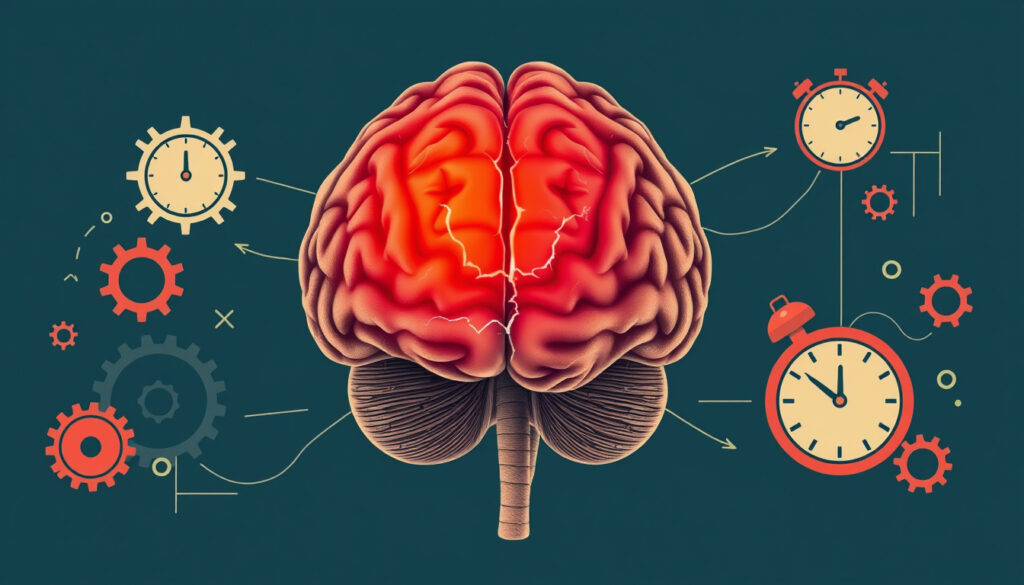
When you make a plan, weigh a risk, or stop yourself from saying something you’ll regret, there’s a small region of your brain running the show. That’s your frontal lobe — the command center for some of the most complex human behaviors.
Frontal lobe size: About 30% of the cerebral cortex ·
Full development age: Mid‑20s to early 30s ·
Functions controlled: Voluntary movement, expressive language, executive functions, personality, memory ·
Common damage cause: Traumatic brain injury, stroke, tumors
Quick snapshot
- Voluntary movement and motor control (Cleveland Clinic (neurology resource))
- Expressive language via Broca’s area (PubMed / Executive Dysfunction Review) (Cleveland Clinic (neurology resource))
- Executive functions: planning, inhibition, working memory (MedLink Neurology (clinical neurology reference)) (Cleveland Clinic (neurology resource))
- Personality and social behavior (PubMed / Executive Dysfunction Review) (Cleveland Clinic (neurology resource))
- Memory encoding and retrieval (Cleveland Clinic (neurology resource)) (Cleveland Clinic (neurology resource))
- Front of the brain, behind the forehead (Cleveland Clinic)
- Largest lobe of the cerebral cortex (MedLink Neurology)
- Contains the prefrontal cortex, motor cortex, and Broca’s area (PubMed)
- Traumatic brain injury (especially at bony ridges) (MedLink Neurology)
- Stroke (anterior cerebral artery territory) (Cleveland Clinic)
- Tumors and infections (PubMed)
- Neuroplasticity allows some reorganization (MedLink Neurology)
- Early cognitive rehabilitation improves outcomes (Cleveland Clinic)
- Partial improvement is common; complete recovery rare (PubMed)
Five key facts, one takeaway: the frontal lobe is a multi‑tasker whose distinct subregions each pull a different lever of cognition and behavior.
| Fact | Detail |
|---|---|
| Lobe size | 30% of cerebral cortex (MedLink Neurology) |
| Development completion | Late 20s to early 30s (Cleveland Clinic) |
| Key neurotransmitter | Dopamine (reward, attention, planning) (PubMed) |
| Common damage symptom | Executive dysfunction (MedLink Neurology) |
| Famous case | Phineas Gage — personality change after frontal lobe injury (Cleveland Clinic) |
The frontal lobe’s subregions are not interchangeable; a lesion in the dorsolateral prefrontal cortex impairs working memory, while damage to the orbitofrontal cortex alters personality. Knowing which subregion is affected is critical for diagnosis and rehabilitation.
What are the 5 things the frontal lobe does?
Voluntary movement and motor control
- The primary motor cortex (precentral gyrus) in the frontal lobe initiates and coordinates voluntary muscle movements (Cleveland Clinic).
- Each side of the motor cortex controls movement on the opposite side of the body (MedLink Neurology).
- Damage here can cause contralateral hemiparesis or hemiplegia (PubMed).
The front part of the frontal lobe—the premotor cortex—handles planning of movements before execution, a job that depends on sensory feedback and internal models of action.
The pattern: voluntary movement is not random; it’s a sequence of planned, executed, and corrected commands all routed through the frontal lobe’s motor networks.
Expressive language (Broca’s area)
- Broca’s area, located in the left inferior frontal gyrus, is essential for speech production and grammatical structure (PubMed / Executive Dysfunction Review).
- Damage to Broca’s area results in expressive aphasia—the patient knows what they want to say but cannot form the words (Cleveland Clinic).
- The frontal lobe also contributes to nonverbal communication and social use of language (MedLink Neurology).
Language production is the most lateralized frontal lobe function—over 95% of right‑handed individuals have left‑hemisphere dominance for speech.
Executive functions (planning, decision‑making, problem‑solving)
- Executive functions include working memory, cognitive flexibility, and inhibition (PubMed / Executive Dysfunction Review).
- The dorsolateral prefrontal cortex supports goal‑directed attention, task switching, planning, and novelty seeking (MedLink Neurology).
- The ventrolateral prefrontal cortex handles inhibition, response selection, and monitoring (PubMed).
- Executive function regulates other cognitions, including memory, perception, emotion, and action execution (MedLink Neurology).
Why this matters: executive dysfunction is the most common consequence of frontal lobe damage and can mimic dementia, ADHD, or depression, making accurate diagnosis essential.
Personality and social behavior
- The orbitofrontal cortex links to personality, inhibition, and emotional and social reasoning (PubMed / Executive Dysfunction Review).
- The medial prefrontal cortex supports self‑knowledge, motivation, emotional regulation, and updating goal‑directed behavior (PubMed).
- The classic case of Phineas Gage showed that frontal lobe injury can fundamentally alter a person’s social judgment and personality without affecting intelligence (Cleveland Clinic).
Memory storage and retrieval
- Short‑term memory and prospective memory (remembering to do things in the future) depend on frontal lobe integrity (MedLink Neurology).
- The prefrontal cortex encodes and retrieves information by coordinating with the hippocampus and temporal lobes (PubMed).
- Patients with frontal lobe damage often have intact long‑term memory but struggle with working memory and strategic recall (Cleveland Clinic).
The catch: memory is not stored in the frontal lobe, but the lobe acts as a gatekeeper that decides which memories are relevant and needed.
What are symptoms of frontal lobe damage?
Motor symptoms
- Contralateral hemiparesis or hemiplegia if the primary motor cortex is involved (Cleveland Clinic).
- Apraxia — difficulty performing learned motor tasks despite intact strength (MedLink Neurology).
- Loss of fine motor control and coordination (PubMed).
Cognitive symptoms
- Impaired judgment and decision‑making (MedLink Neurology).
- Poor attention, distractibility, and reduced working memory capacity (PubMed).
- Difficulty with planning, organization, and problem‑solving (Cleveland Clinic).
- Executive dysfunction — the hallmark syndrome of frontal lobe injury (MedLink Neurology).
Behavioral changes
- Impulsivity and disinhibition — acting without considering consequences (PubMed).
- Apathy, lack of motivation, and emotional blunting (Cleveland Clinic).
- Socially inappropriate behavior and poor insight into one’s own deficits (MedLink Neurology).
- Three major neuroanatomical variants of executive dysfunction syndrome: orbitofrontal (disinhibited), medial (apathetic), and dorsolateral (dysexecutive) (MedLink Neurology).
Survivors of frontal lobe injury often retain IQ and basic knowledge, yet lose the ability to manage daily life—a gap that frustrates families and challenges rehabilitation teams.
What this means: frontal lobe damage does not uniformly affect everyone; the specific location of the lesion determines whether the patient becomes impulsive, apathetic, or cognitively rigid.
At what age does the frontal lobe fully develop?
Adolescent brain development
- During adolescence, the frontal lobe undergoes significant myelination and synaptic pruning (Cleveland Clinic (neurology resource)).
- The prefrontal cortex is one of the last brain regions to mature (PubMed / Executive Dysfunction Review).
- Adolescents rely more on the limbic system for decision‑making, leading to risk‑taking and impulsivity (MedLink Neurology).
Peak development in mid‑20s
- Most studies indicate the prefrontal cortex reaches full maturation between ages 25 and 30 (Cleveland Clinic).
- Full development includes improved impulse control, risk assessment, and long‑term planning (PubMed).
- The exact age of completion varies individually and may extend into the early 30s (MedLink Neurology).
Continued pruning into early 30s
- Synaptic pruning continues into the early 30s, refining neural connections for efficiency (PubMed).
- Environmental factors such as stress, nutrition, and sleep can accelerate or delay this process (Cleveland Clinic).
- Lifestyle choices (e.g., substance use, sleep deprivation) during the teenage years and 20s can have lasting effects on frontal lobe health (MedLink Neurology).
The implication: for anyone under 25, the frontal lobe is still under construction. That’s not an excuse for poor decisions—it’s a window of opportunity to build healthy habits that support optimal development.
What disorders affect the frontal lobe?
Many conditions that affect the frontal lobe are underdiagnosed because their symptoms overlap with psychiatric disorders. A careful neurological exam can reveal the difference.
ADHD and attention deficits
- ADHD is associated with reduced frontal lobe activity, particularly in the prefrontal cortex (PubMed / Executive Dysfunction Review).
- Executive dysfunction—poor working memory, weak inhibition, difficulty shifting focus—is a core feature (MedLink Neurology).
- Stimulant medications increase frontal lobe dopamine and norepinephrine, improving executive function (Cleveland Clinic).
Schizophrenia
- Schizophrenia involves frontal lobe hypofunction, especially in the dorsolateral prefrontal cortex (PubMed).
- Patients show deficits in working memory, planning, and attention (MedLink Neurology).
- Cognitive remediation therapy attempts to train frontal lobe networks to compensate (Cleveland Clinic).
Frontotemporal dementia
- This condition causes progressive shrinkage of the frontal and temporal lobes (MedLink Neurology).
- Behavioral variant leads to personality changes, apathy, or disinhibition (PubMed).
- Language variant (primary progressive aphasia) impairs speech production and comprehension (Cleveland Clinic).
Traumatic brain injury (TBI)
- The frontal lobes are especially vulnerable to TBI because the bony ridges of the skull can shear their tissue during acceleration‑deceleration (MedLink Neurology).
- Executive dysfunction is the most persistent cognitive deficit after moderate to severe TBI (PubMed).
- Rehabilitation focuses on compensatory strategies for planning, organization, and behavioral regulation (Cleveland Clinic).
Stroke and tumors
- Stroke affecting the anterior cerebral artery territory can lead to frontal lobe syndromes (MedLink Neurology).
- Frontal lobe tumors may cause subtle personality changes before other symptoms appear (PubMed).
- Surgical resection of frontal lobe tumors often sacrifices some executive function, but patients can adapt with rehabilitation (Cleveland Clinic).
The pattern: whether the cause is psychiatric, neurodevelopmental, or acquired, frontal lobe involvement consistently leads to executive dysfunction—a shared final pathway that unites these otherwise distinct conditions.
Can frontal lobe damage be fixed?
Neuroplasticity and recovery potential
- The brain can reorganize itself; adjacent areas may take over some lost functions (MedLink Neurology (clinical research)).
- Neuroplasticity is most robust in younger patients but continues throughout life (PubMed / Executive Dysfunction Review).
- Reorganization is limited by lesion size and proximity to other critical networks (Cleveland Clinic (neurology resource)).
Rehabilitation strategies
- Cognitive rehabilitation includes goal management training, problem‑solving therapy, and metacognitive strategy instruction (PubMed).
- Physical therapy can help with motor deficits, while speech therapy addresses language impairments (Cleveland Clinic).
- Early and intensive rehabilitation significantly improves functional outcomes (MedLink Neurology).
Limitations and permanent deficits
- Complete recovery is rare; many patients retain lasting cognitive or behavioral changes (PubMed).
- Factors such as age, severity, lesion location, and pre‑morbid cognitive reserve influence recovery extent (MedLink Neurology).
- Behavioral changes (e.g., apathy, disinhibition) may persist even when cognitive functions improve (Cleveland Clinic).
Clarity check
Confirmed facts
- Frontal lobe controls voluntary movement (Cleveland Clinic).
- Frontal lobe develops into the mid‑20s (PubMed / Executive Dysfunction Review).
- Damage affects executive function, language, and personality (MedLink Neurology).
What’s unclear
- Exact age of full development varies between 25 and 30, and may extend into early 30s (PubMed).
- Degree of recovery from damage is highly individualized and depends on unmeasured factors like cognitive reserve (MedLink Neurology).
- Whether intensive rehabilitation can restore complex social judgment remains uncertain (Cleveland Clinic).
- Executive function comprises working memory, cognitive flexibility, and inhibition (PubMed / Executive Dysfunction Review).
- Three major neuroanatomical variants of executive dysfunction tied to orbitofrontal, medial, and dorsolateral regions (MedLink Neurology).
What the experts say
“The prefrontal cortex helps with your attention, emotions, self‑control, and decision‑making. It sits behind the forehead and does not finish developing until the mid‑20s.”
Cleveland Clinic (neurology resource)
“Executive function depends on top‑down, goal‑driven control of distributed processes throughout the brain. The dorsolateral prefrontal cortex supports working memory, goal‑driven attention, task switching, planning, problem‑solving, and novelty‑seeking.”
PubMed / Executive Dysfunction and the Prefrontal Cortex (academic review)
“Three major neuroanatomical variants of executive dysfunction syndrome can be distinguished: orbitofrontal, medial, and dorsolateral. Focal brain injury causes executive dysfunction most often, or most severely, after frontal lobe injury.”
The frontal lobe isn’t just one part of the brain—it’s a collection of interdependent systems that make us who we are. When they work well, we can plan, create, connect, and adapt. When they break down, the consequences ripple through every aspect of life. For anyone in their teens or early twenties, the message is clear: your frontal lobe is still a work in progress—invest in sleep, stress management, and good nutrition, or risk undermining its development.
Frequently asked questions
Does the frontal lobe control emotions?
The frontal lobe, particularly the medial prefrontal cortex and orbitofrontal cortex, plays a key role in emotional regulation, appraisal, and the integration of emotion with decision‑making (PubMed).
What is the difference between frontal lobe and prefrontal cortex?
The frontal lobe is the entire anterior part of the brain; the prefrontal cortex is the frontmost part of the frontal lobe, responsible for higher‑order cognitive functions like planning, social reasoning, and impulse control (Cleveland Clinic).
How does alcohol affect the frontal lobe?
Alcohol acutely depresses frontal lobe activity, impairing judgment, inhibition, and decision‑making. Chronic heavy use can lead to lasting damage, including prefrontal cortex shrinkage and executive dysfunction (MedLink Neurology).
Can stress damage the frontal lobe?
Chronic stress elevates cortisol levels, which can impair prefrontal cortex structure and function, reducing working memory, attentional control, and cognitive flexibility (PubMed).
Does the frontal lobe control balance?
Balance is primarily regulated by the cerebellum and brainstem, not the frontal lobe. However, the frontal lobe contributes to voluntary movement planning and postural adjustments that support balance (Cleveland Clinic).
What is the role of the frontal lobe in decision‑making?
The frontal lobe—especially the dorsolateral and ventromedial prefrontal cortices—evaluates options, calculates risks and rewards, and selects actions based on goals and past outcomes (PubMed).
Can frontal lobe function be improved with exercise?
Aerobic exercise increases blood flow and neurotrophic factors in the frontal lobe, enhancing executive functions like attention, working memory, and cognitive flexibility (MedLink Neurology).
How does frontal lobe damage affect sleep?
The frontal lobe regulates sleep‑wake cycles and circadian rhythms. Damage can lead to insomnia, fragmented sleep, or disorders such as fatal familial insomnia when the anterior cingulate and prefrontal regions are involved (PubMed).