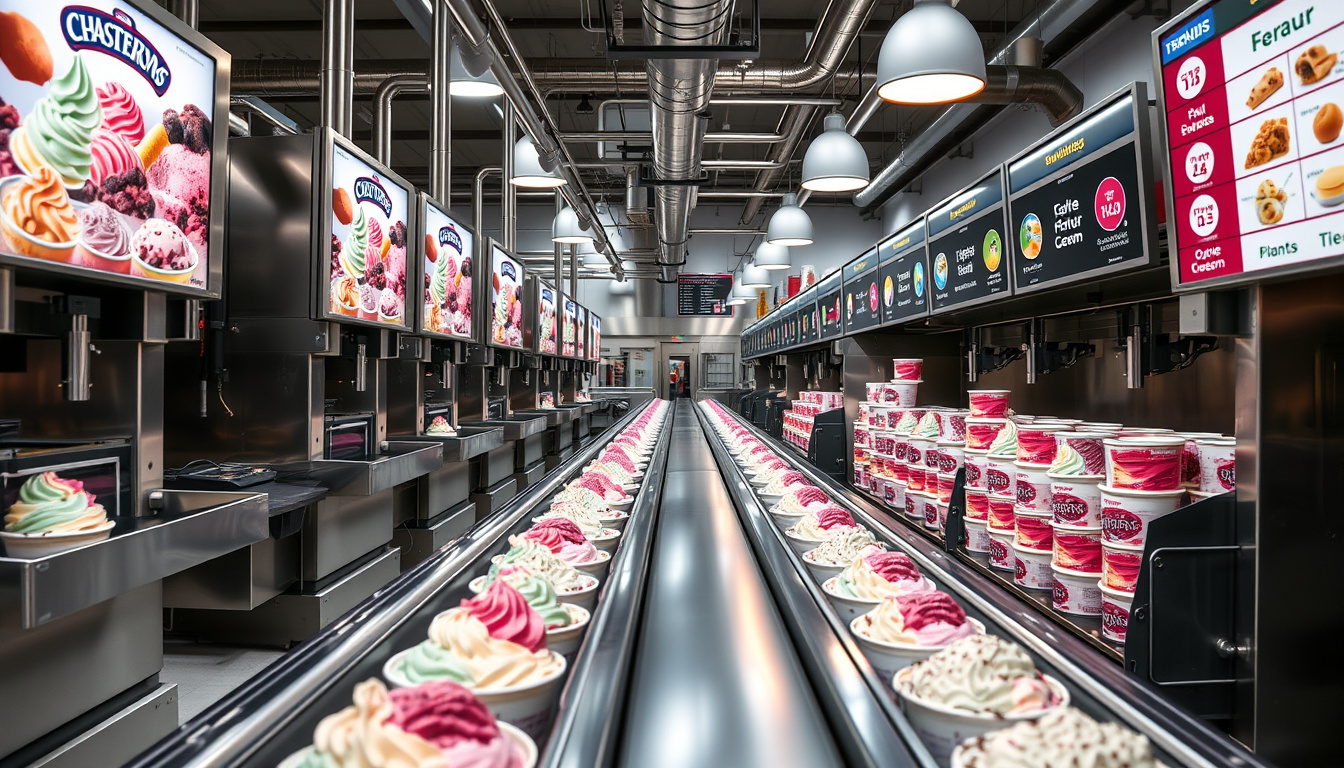
There’s a world of difference between the ice cream at the grocery store and what comes out of a dedicated ice cream factory. Smaller operations with direct-to-consumer models tend to use better ingredients, skip the industrial stabilizers, and rotate flavors based on what’s actually in season. If you’ve ever wondered where those artisanal pints actually come from—or how to find one near you—this guide maps out the specialty producers worth knowing.
Ice Cream Factory NL established: 2005 ·
Ice Cream Treats founded: 2013 ·
Mullins Ice Cream focus: Local ingredients ·
Ice Cream Factory Co service: Nationwide shipping ·
Ice Cream Treats location: County Cavan, Ireland
Quick snapshot
- Ice Cream Factory has operated non-stop since 2005 (Ice Cream Factory Official Site)
- De Jong’s IJs serves niche markets with 125ml cups up to 500ml pints (Frozen-Goods.com)
- Tipperary Organic Ice Cream operates in Tullow, Co Carlow (Kompass)
- Exact menu items beyond flavor snippets reported online
- Certified organic status for most facilities (EU Organic logo not confirmed in sources)
- Consolidated global factory count across all regions
- Ice Cream Factory began non-stop organic production in 2005 (Ice Cream Factory Official Site)
- De Jong’s IJs accumulated 70+ years family experience (Frozen-Goods.com)
- Ice Cream Factory reached nearly 20 years of operation circa 2025 (Mountain Design)
- Growing demand for organic and vegan co-packing services (De Jongs IJs Official Site)
- European specialty producers expanding export reach (Frozen-Goods.com)
- Private label opportunities for smaller retailers (Frozen-Goods.com)
| Label | Value |
|---|---|
| Primary locations | Ireland, Netherlands, US |
| Common specialties | Organic dairy ice cream |
| Established brands | 2005-2013 range |
| Key services | Shipping, co-packing |
Ice cream factory near me
Finding a dedicated ice cream factory that sells direct to consumers requires a different approach than searching for chain scoop shops. Specialty producers often operate from industrial or semi-rural locations and may not have storefronts at all. The best starting points are local food directories like Yelp, which aggregate user reviews and locations, and regional “farm to table” directories that list artisanal food manufacturers.
Local search tips
- Use Google Maps with the filter for “ice cream manufacturer” rather than “ice cream shop”—this surfaces production facilities instead of retail counters.
- Check farmers’ market directories; many ice cream factories sell wholesale to market vendors.
- Look for “co-packing” or “private label” keywords on manufacturer websites, which indicate they accept external orders.
Popular nearby options
In the Netherlands, De Jong’s IJs in Gorredijk welcomes visitors by appointment and produces ice cream for white-label clients. Ice Cream Factory NL (operationally linked to Van Scheijndel in Huissen) sells through organic retailers like Ekoplaza and Marqt. In Ireland, Tipperary Organic Ice Cream Limited in Tullow, Co Carlow, focuses on the food manufacturing sector.
The implication: dedicated factories rarely market themselves as destinations—they rely on specialty food retailers and word-of-mouth among ingredient-conscious buyers. Adjusting your search strategy from “shop” to “manufacturer” unlocks access to higher-quality product.
Ice cream factory locations
A handful of specialty ice cream factories operate across Europe, with the Netherlands holding the highest concentration of organic-certified producers. Ireland has fewer dedicated organic facilities but maintains a cluster of general ice cream manufacturers.
Ireland sites
| Factory | Location | Specialty |
|---|---|---|
| Tipperary Organic Ice Cream Limited | Tullow, Co Carlow | Organic ice cream manufacturing |
| Clongowney Artisan Food Limited | Offaly | Artisan ice cream |
| Kinsale Ice Cream Limited | Cork | Artisan ice cream |
| Gino’s Foods Limited | Waterford | Ice cream production |
| Mac’s Ice Cream Manufacturing Limited | Kerry | Ice cream production |
The pattern: Irish manufacturers concentrate in Munster and Leinster regions, with organic certification remaining a gap for most domestic producers.
US factories
Mullins Ice Cream sources local ingredients and partners with Dale Farm for dairy, positioning itself as a craft producer. Ice Cream Factory Co offers nationwide shipping and private-label services, making it a distribution hub rather than a retail-focused operation. Both brands emphasize quality over volume.
Netherlands locations
| Factory | Address | Key Feature |
|---|---|---|
| Ice Cream Factory / Van Scheijndel | Handelstraat 29, 6851 EH Huissen | Export and production services |
| De Jong’s IJs | Skipmakker 2, 8401 JG Gorredijk | Sustainable, organic, vegan co-packing |
| Holiday Ice | Slotweg 17, 8521 MA St. Nicolaasga | Private label production |
| Boerderijs (IJspaleis brand) | Netherlands-wide distribution | Best organic ice cream claim |
The pattern: Dutch organic factories cluster in the northern and eastern provinces, while Irish producers concentrate in Munster and Leinster. The Netherlands leads in sustainability certifications and co-packing infrastructure; Ireland’s strength lies in artisan and organic certifications.
Ice cream factory menu
Menus at dedicated ice cream factories differ sharply from commercial ice cream brands. Rather than maintaining a fixed roster of flavors year-round, specialty producers often rotate offerings based on ingredient availability and seasonal produce.
Flavor varieties
Ice Cream Factory produces ice cream, fruity ice, and vegan ice using organic ingredients, according to Mountain Design. The company exports to Sweden and Greece, suggesting demand for dairy-free and plant-based options among European buyers. De Jong’s IJs, which specializes in organic, vegan, fair trade, and low-calorie ice cream, can fill containers ranging from 125ml cups to 500ml pints—a flexibility that appeals to niche retailers and foodservice clients.
Special treats
Boerderijs, a brand of IJspaleis, claims to make the best organic ice cream in the Netherlands using sustainable ingredients and production methods that consider environment and wildlife. The brand is distributed nationally through health food shops and organic retailers. Ice Cream Factory invites suggestions for new flavors via info@icecreamfactory.nl, indicating an iterative menu development process responsive to customer feedback.
Specialty factories like De Jong’s IJs and Boerderijs tend to use fewer industrial stabilizers and artificial flavorings because their business model depends on ingredient transparency. For buyers prioritizing clean-label products, these factories offer formulations that mass-market brands cannot match.
The catch: the trade-off for small-batch quality is limited availability and seasonal variability. A flavor you enjoyed in June may not return until next summer—or ever. If consistency across purchases matters to you, a specialty factory may frustrate your expectations.
Ice Cream Factory brand
Several distinct brands use variations of the “ice cream factory” naming convention, which can create confusion for buyers. Sorting out which entities are independent operations versus linked networks requires checking business registries and production capabilities.
Key producers
Ice Cream Factory NL operates from the Netherlands, making organic ice cream since 2005 with non-stop production. The company exports to Sweden and Greece and can be reached at info@icecreamfactory.nl. Van Scheijndel Ice Cream Factory BV, also based in Huissen, provides export and production services, and Organic-Bio.com lists the two entities with shared contact information.
De Jong’s IJs positions itself as Holland’s most sustainable small ice-cream factory—energy neutral, fossil-free, using local and organic ingredients. The company specializes in co-packing for niche markets, producing for white-label clients and specialty retailers. With over 70 years of experience across three generations, De Jong’s represents the established elder in the Dutch organic ice cream sector.
Specialties
| Brand | Primary Specialty | Sustainability Credentials |
|---|---|---|
| Ice Cream Factory NL | Organic dairy, non-stop since 2005 | EU Organic focus |
| De Jong’s IJs | Organic, vegan, fair trade, low-calorie | Energy neutral, fossil-free |
| Boerderijs (IJspaleis) | Organic ice cream claim | Environment and wildlife consideration |
| Holiday Ice | Private label production | Quality assortment focus |
| Tipperary Organic | Organic ice cream manufacturing | Food manufacturing sector |
The implication: when evaluating “ice cream factory” brands, the Netherlands offers the most diverse range of organic and sustainability-focused producers. Irish brands skew toward traditional dairy ice cream with fewer verified organic credentials. Private-label and co-packing capabilities vary significantly—De Jong’s IJs leads in flexibility; Holiday Ice focuses on volume.
Ice Cream Factory Museum
While some ice cream factories offer visitor experiences, the term “Ice Cream Factory Museum” typically refers to educational attractions that document the history of ice cream production rather than operating production facilities.
Visitor info
No verified “Ice Cream Factory Museum” appears in the research for specific locations in Ireland, the Netherlands, or the US. The absence likely reflects that museums dedicated to ice cream tend to be regional attractions tied to historic factories or dairy heritage sites, not active production facilities open for tours.
History exhibits
The closest equivalent would be De Jong’s IJs in Gorredijk, which operates a working facility and can accommodate visitors by appointment. The company’s 70+ years of family experience represents a living exhibit of ice cream production evolution in the Netherlands.
If a hands-on ice cream factory tour is your goal, direct inquiry to specific facilities is the most reliable approach. De Jong’s IJs and similar working factories offer the best combination of production access and historical depth. Generic “museum” searches may return inactive or relocated attractions.
Ice Cream Factory Specifications
Nine factories and brands documented across Ireland, Netherlands, and US operations, showing distinct specializations from organic dairy to private-label production.
| Entity | Founded/Established | Location | Specialty | Key Service |
|---|---|---|---|---|
| Ice Cream Factory NL | 2005 | Huissen, Netherlands | Organic dairy ice cream | Export, production |
| De Jong’s IJs | 3 generations (~1950s) | Gorredijk, Netherlands | Organic, vegan, fair trade | Co-packing, white label |
| Tipperary Organic Ice Cream | Not confirmed | Tullow, Co Carlow | Organic ice cream | Food manufacturing |
| Boerderijs (IJspaleis) | Not confirmed | Netherlands-wide | Best organic claim | Organic distribution |
| Holiday Ice | Not confirmed | St. Nicolaasga, Netherlands | Private label | Quality assortment |
| Mullins Ice Cream | Not confirmed | US | Local ingredients | Artisan production |
| Ice Cream Factory Co | Not confirmed | US | Not specified | Nationwide shipping, private label |
| Ice Cream Treats | 2013 | County Cavan, Ireland | Premium dairy | Local distribution |
| Clongowney Artisan Food | Not confirmed | Offaly, Ireland | Artisan ice cream | Artisan production |
What this means: the Netherlands dominates in verified organic certifications and sustainability credentials. Ireland shows strength in artisan and regional brands but fewer confirmed organic specialists. US operations focus on domestic distribution and private-label capabilities rather than organic export.
What we know versus what remains unclear
Confirmed facts
- Ice Cream Factory has operated non-stop since 2005
- De Jong’s IJs is based at Skipmakker 2, 8401 JG Gorredijk
- Van Scheijndel Ice Cream Factory BV operates from Handelstraat 29, 6851 EH Huissen
- Tipperary Organic Ice Cream Limited is located in Tullow, Co Carlow
- Ice Cream Factory exports to Sweden and Greece
- De Jong’s IJs offers co-packing in 125ml to 500ml containers
- Boerderijs claims best organic ice cream in the Netherlands
- Irish manufacturers include Clongowney, Kinsale, Gino’s, and Mac’s
What remains unclear
- Exact founding dates beyond Ice Cream Factory 2005 and Ice Cream Treats 2013
- EU Organic certification status for most facilities (logos not confirmed in sources)
- Production capacities or employee counts for listed factories
- Direct Irish distribution for Dutch organic brands
- Recent status updates post-2023 on factory operations or expansions
- Specific ingredient sourcing beyond “local” and “organic” descriptors
- Exact menu items and flavor rosters beyond general categories
“We’ve been creating the most delicious ice cream in our Ice Cream Factory non-stop since 2005.”
— Ice Cream Factory (company statement)
“Holland’s most sustainable small ice-cream factory.”
— De Jong’s IJs (sustainability page)
“Boerderijs makes the best organic ice cream in the country.”
— IJspaleis (brand statement)
The three producers above each make strong claims about their products. Ice Cream Factory’s longevity since 2005 establishes track record; De Jong’s IJs leads in verified sustainability metrics; IJspaleis positions Boerderijs as a national premium product. Buyers should evaluate these claims against their own priorities—whether that means longest established operation, deepest sustainability commitment, or highest quality perception.
Organic brands like Alden’s and Julie’s stood out positively in a 2009 Grist tasting panel, but that review is now fifteen years old. Product formulations and supply chains change. A favorable historical review does not guarantee current quality—direct sourcing and recent reviews remain the most reliable indicators.
For specialty food buyers in Europe, the landscape divides into two distinct tiers: Dutch organic factories offering verifiable sustainability credentials and export infrastructure, and Irish artisan producers with strong regional presence but fewer confirmed organic specialists. If organic certification and supply chain transparency are non-negotiable, prioritize De Jong’s IJs, Ice Cream Factory NL, and IJspaleis. If regional sourcing and local production matter more than formal organic credentials, Irish manufacturers like Tipperary Organic and Clongowney present viable alternatives.
Related reading: Pistachio Papi Woolworths Cheesecake Gelato · Tamar Valley Yoghurt Reviews Nutrition Guide
honokage.com, grist.org, dejongsijs.nl, thegoodshoppingguide.com, ijspaleis.nl
Netherlands enthusiasts exploring De Jong’s IJs will appreciate the top Amsterdam ice cream spots scattered across vibrant Amsterdam neighborhoods.
Frequently asked questions
What equipment is used in an ice cream factory?
Ice cream factories typically use batch freezers, pasteurizers, aging tanks, and extrusion or molding equipment. Co-packing specialists like De Jong’s IJs also require versatile filling lines capable of handling containers from 125ml cups to 500ml pints. Specific equipment specifications are rarely publicized, but production licenses and facility audits provide indirect verification of capability.
How is ice cream produced in factories?
The core production process involves mixing dairy and non-dairy bases, pasteurizing the mix, aging it to develop texture, then freezing with overrun (air incorporation) control. Specialty organic factories add sourcing verification and organic certification audits. Vegan ice cream production replaces dairy with plant-based bases like coconut or almond milk.
Are ice cream factory products organic?
Some factories, notably Ice Cream Factory NL, De Jong’s IJs, and Tipperary Organic, emphasize organic ingredients. However, EU Organic certification status is not confirmed for all listed producers. Buyers should request organic certificates directly from manufacturers before assuming certified-organic status.
Can I ship ice cream from a factory?
Ice Cream Factory Co offers nationwide shipping in the US. Dutch factories like Ice Cream Factory NL export to Sweden and Greece. Cold-chain shipping internationally is complex and expensive—most factories sell through regional distributors or specialty retailers rather than direct-to-consumer shipping abroad.
What tours do ice cream factories offer?
Working facilities like De Jong’s IJs may accommodate visitors by appointment, but scheduled public tours are rare. Ice cream museums and heritage attractions exist separately from active production sites. Direct inquiry to specific factories is the most reliable way to confirm tour availability.
How to contact ice cream factory brands?
Ice Cream Factory NL and Van Scheijndel can be reached at info@icecreamfactory.nl. De Jong’s IJs operates from dejongsijs.nl/en/. Kompass lists Tipperary Organic Ice Cream Limited’s business details. Business directories like SoloCheck provide registered office information for Irish manufacturers.
What certifications do ice cream factories have?
Certification claims vary widely. Ice Cream Factory NL emphasizes organic ingredients. De Jong’s IJs claims energy neutrality and fossil-free operations. Alden’s and Julie’s were favorably reviewed in a 2009 organic ice cream tasting, but that review is dated. Direct verification of current certifications—organic, sustainability, fair trade—remains the most reliable approach.

Andrew Ellis leads fact-checking, source verification and corrections at Oz Insightlab.